

The best shooters aren't born in games — they're built in driveways, garages, and basements, one rep at a time. You don't need ice, a net, or expensive gear to get a harder, more accurate shot. You need a puck (or a green biscuit), a sheet of plywood or a shooting pad, and a plan.
Below are seven at-home hockey shooting drills you can start today. Do them a few times a week this off-season and the results show up the moment you're back on the ice. And because feeling like you're improving isn't the same as knowing, we'll show you how to put a number on every rep at the end.
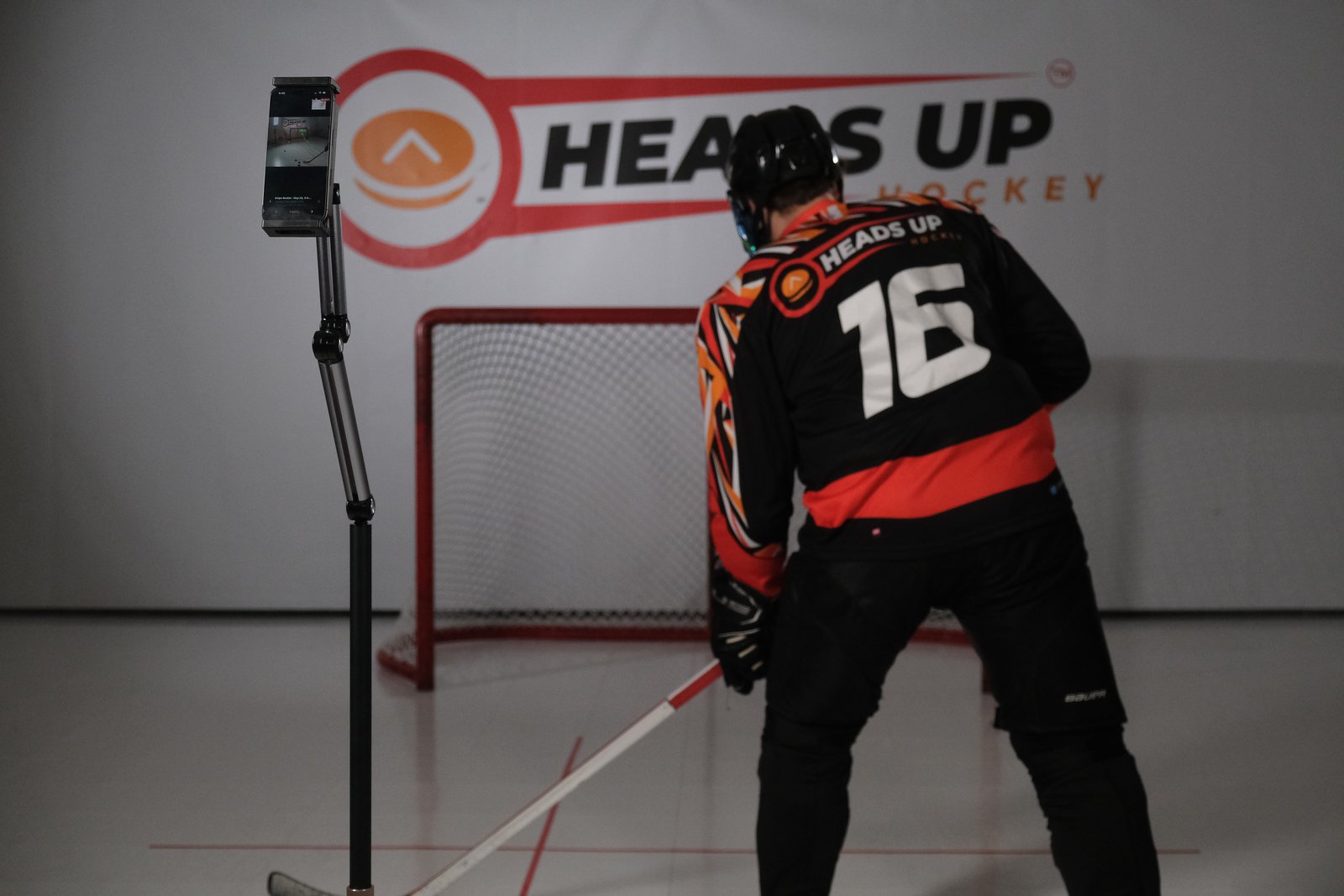
1. The Stationary Wrist Shot (build the foundation)
Start still and slow. Weight on your back leg, puck in your shooting stance, and roll the puck from heel to toe of the blade as you transfer weight forward and follow through pointing at your target. Fire 25 to each corner.
This is where a good wrist shot is built — clean mechanics before power. Resist the urge to crank it. You are teaching your hands a pattern, and a sloppy pattern repeated 500 times is just a sloppy pattern you can now perform quickly.
2. Weight-Transfer Snap Shots
The snap shot is your quick-release weapon. Set the puck slightly ahead of your stance, load the stick by pushing down into it, and snap your wrists as you transfer weight. The goal is a fast release, not a wind-up — the less time the goalie has to react, the better. 25 reps each side.
Power in a snap shot comes from loading the stick and driving your weight through it, not from your arms. If your arms are sore and your legs aren't, you're doing it with the wrong muscles.
3. Toe-Drag to Shot
Great shooters change the angle before they fire. Pull the puck toward you with the toe of your blade (the toe drag), then release. This teaches you to shoot off a moving puck — exactly what happens in a game, and almost never what happens when you practice from a dead stop.
Alternate forehand and backhand finishes.
4. Quick-Release Off the Pass
Lean a board or a rebounder against a wall, bank the puck off it, and shoot the return in one motion. No settling, no extra stickhandle. Catch-and-release is what separates players who score from players who "almost" score. Aim for a clean shot within one second of the puck hitting your blade.
5. Target Practice (accuracy over power)
Tape four targets to your shooting tarp or plywood — top corners and low corners. Call your shot before you take it, then hit it. Score yourself out of 20.
Placement beats power. A 60 mph shot in the corner beats an 80 mph shot into the goalie's chest every time.
"The biggest mistake is just trying to hit the puck as hard as they can — not the technique, head up, hitting spots. It's not all about speed; accuracy is super important."
— Josie Hemp, University of Rhode Island
Coach's tip — the "miss circle": Film 10 pucks, draw the net over the video, and mark where each shot actually went. That cluster is your miss circle. Your only job all summer is to shrink it. As Coach Lance puts it, an NHL or PWHL player's miss circle is so tight "they're hitting the post or the crossbar. That's how good you can get."
6. Backhand Reps (the shot everyone skips)
Nobody practices their backhand, which is exactly why it's a scoring chance. Same mechanics as your wrist shot, mirrored. Get the puck up. 20 reps.
Coach Lance runs a diagnostic on every player he meets: "Is most of your time at home with a pile of pucks ripping forehand shots? Do you spend the same time on your backhand as your forehand?" Almost everyone says no — which means, as he puts it, "their actions aren't lining up with their goals." Your future breakaway self will thank you.
7. The Rapid-Fire Set (game-speed conditioning)
Line up 10 pucks. Shoot all 10 as fast as you can keep your form clean, resetting your feet each time. This trains a repeatable shot under fatigue — the kind you'll need in the third period.
The moment your form breaks, stop. Ten clean reps beat twenty ugly ones.
Keep your eyes up
Every drill above gets more valuable the moment you stop staring at the puck. Rhett Pitlick puts his finger on the most common error he sees: "they're shooting the puck with their head down, never looking up."
Josie Hemp had the same problem, and fixed it deliberately: "I've struggled with keeping my head down — stickhandling and shooting with my head down." In a game, your eyes tell you where the goalie isn't. If they're on the puck, you're shooting blind.
How many shots should you take?
The players who make the biggest jumps treat volume like a habit. A common off-season goal is the 10,000-shot challenge — that's roughly 100–150 shots a day, five days a week. It sounds like a lot until you realize these drills get you there in 20–30 minutes.
And don't worry that it's "only" your driveway:
"The hockey gods can't tell the difference between an on-ice or off-ice rep. It's just a rep."
— Coach Lance
Turn "practice" into progress you can measure
Here's the trap with at-home training: it's almost impossible to tell if you're actually getting better, or just getting reps. Is your release faster than last month? Is your shot harder? Are you hitting your spots more often? Are you keeping your head up, or only think you are?
That's the problem Heads Up Shooting was built to solve. It uses your phone to measure your release time, shot speed, accuracy, and head-up rate — no extra hardware, no radar gun, no recording-and-guessing. It shows you exactly where each puck went, so your miss circle stops being a feeling and starts being a picture.
Your phone becomes the radar gun, the target, and the coach. As Coach Lance says, "you don't make any progress unless you track it."
Run these seven drills, and instead of hoping you improved, you'll watch the numbers climb.
Ready to put a number on every shot?
Download Heads Up Shooting free on the App Store — or grab lifetime access for $175 and train all summer.
Related reading: How to Measure Your Hockey Shot Speed With Just Your Phone · Best Hockey Training Aids for 2026: A Parent's Buying Guide
Frequently asked questions
Can you really practice hockey shooting at home?
Yes. With a shooting pad or a sheet of plywood and a puck (or a synthetic-ice puck), every drill above works in a garage, basement, or driveway. Off-ice reps build the muscle memory and strength that show up on the ice.
How many shots a day should a youth player take?
Consistency beats intensity. 100–150 focused shots a day, five days a week, adds up to about 10,000 over a summer — enough to visibly change a player's release and accuracy.
What's the best drill to shoot the puck harder?
Weight-transfer snap shots (drill #2). Power comes from loading the stick and transferring your weight into the shot, not from your arms. Film it or measure it so you can see the release speed improve over time.
Do I need special equipment?
No. A puck, something to shoot into (plywood, tarp, or shooting pad), and optionally a rebounder. To measure your progress, all you need is your phone and the Heads Up Shooting app.
How long until I see improvement?
Most players notice a faster release within 3–4 weeks of consistent daily reps. Accuracy gains show up faster than power gains, because accuracy is mostly a mechanics-and-attention problem, while power also depends on strength.


