

Every player wants to know one number: how hard do I shoot?
A hockey radar gun is the traditional answer, and it works — it's what scouts and coaches use. But it starts at $299.99, it measures only speed, and getting it set up is a small ritual every session. For a player shooting alone in the driveway, those are real problems.
So before you buy one: here are the three ways to measure your shot speed, what each actually costs, and which one still works when nobody else is around.
Option 1: The stopwatch method (free, and not very good)
Measure a known distance — say 20 feet from your shooting pad to the backstop. Film your shot in slow motion, count the frames from puck-leaves-blade to puck-hits-target, and do the math:
Speed (mph) = distance in feet ÷ time in seconds × 0.682
If the puck travels 20 feet in 0.20 seconds, that's 100 ft/s, or about 68 mph.
This works, technically. In practice you'll spend two minutes of editing per shot, your frame counting will be off by a frame or two (which is a large error at these speeds), and you will do it exactly once. It also tells you nothing about accuracy or release time.
Useful to understand the physics. Useless as a training habit.
Option 2: A radar gun (accurate, expensive, narrow)
Point it, get a number. Pocket Radar and similar devices are genuinely accurate, and this is what scouts use. For hockey there are two models: the Ball Coach at $299.99 and the Smart Coach at $399.99 (prices checked 2026-07-20).
Let's be fair to them first, because a lot of blogs get this wrong: you don't need someone holding it. Both models have a hands-free "Constant-On" mode and mount to a standard tripod. Set it up, shoot, walk over and read your numbers.
But there are real limits for a player training at home:
- It measures one thing. Speed. Not release time, not accuracy, not where the puck actually went.
- The setup is a ritual. The mount is sold separately ($24.99–$34.99), the unit has to be aimed roughly in line with the puck's path, and Pocket Radar's own specs list Constant-On battery life at "over 1 hour" on the included alkalines — about two on rechargeables. That's fine for a session; it's not something you leave running all summer.
- Only the $399.99 model reaches your phone. The Ball Coach's product page says plainly that it is "NOT COMPATIBLE with Pocket Radar App." No Bluetooth, no logging — the number lives on the device's screen until you write it down.
- It rewards the wrong instinct. Give a 12-year-old a radar gun and they will start winding up, because the number goes up. That's how you build a slow, telegraphed shot that no goalie is afraid of.
That last point is the one coaches worry about. Josie Hemp:
"The biggest mistake is just trying to hit the puck as hard as they can — not the technique, head up, hitting spots. It's not all about speed; accuracy is super important."
— Josie Hemp
Option 3: Your phone (what we'd actually do)
Your phone already has the sensor: a camera good enough to see the puck leave your blade and reach the net. The hard part was never the hardware — it was the software to read it.
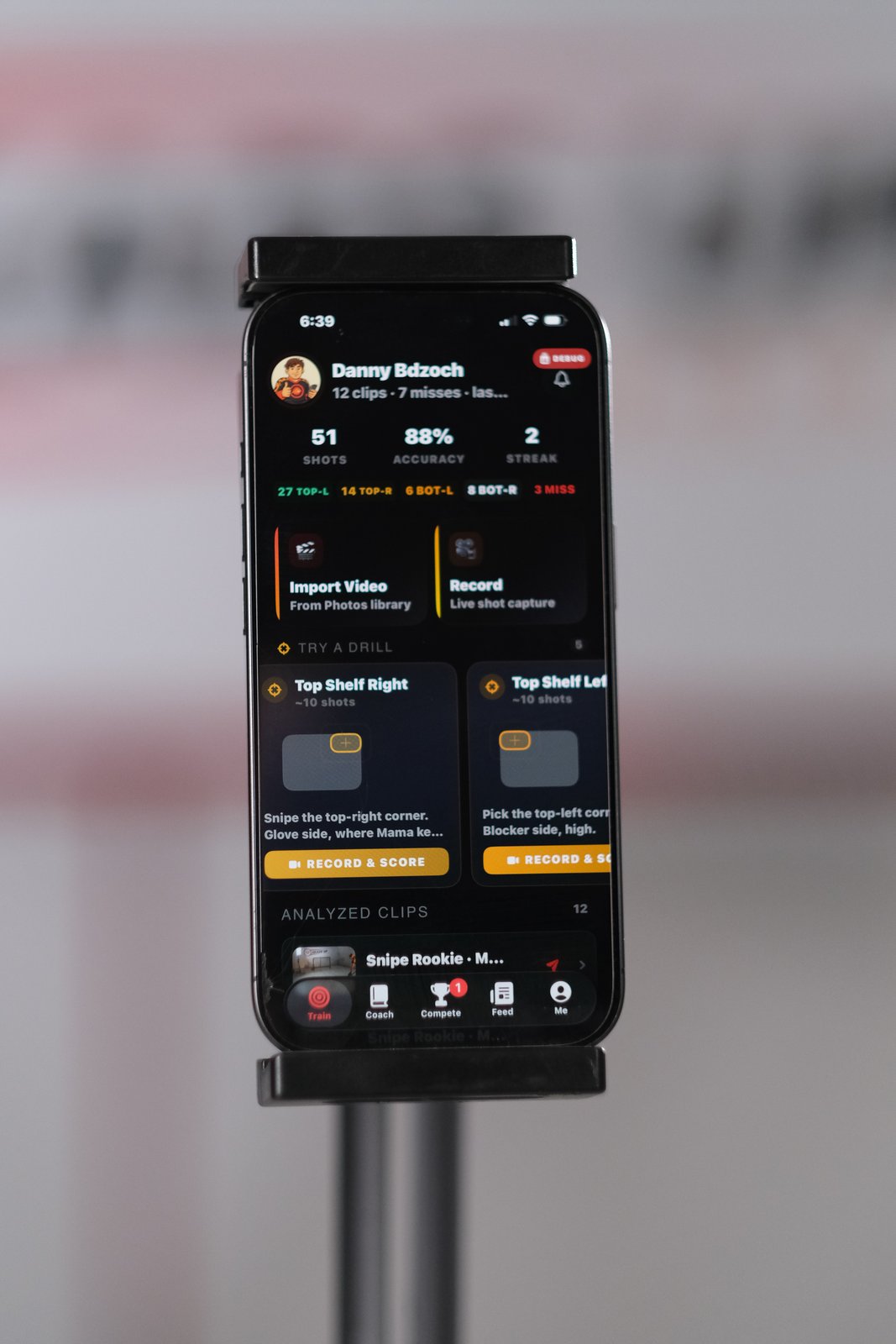
Heads Up Shooting does exactly that. Prop your phone up, shoot, and it measures:
- Shot speed — on every rep, not just the ones someone was watching
- Release time — how long from puck-on-blade to puck-gone. The number goalies actually fear
- Accuracy — did you hit what you called?
- Placement — a map of exactly where each puck went: goals, posts, misses, hit percentage
- Head-up rate — were your eyes up, or on the puck?
No radar gun. No sensors on your stick. No mount to aim. It's the difference between measuring one shot and measuring every shot.
How to set it up
- Prop your phone where it can see both you and the net — a tripod, a puck bucket, a chair.
- Make sure the net or target is fully in frame.
- Shoot. The app logs each rep automatically.
- Review the placement map at the end of the session.
That last step is where the improvement actually happens.
What the numbers mean
Speed is the number everyone asks about, so let's put it in context — and then explain why it's the least important of the four.
Shot speed varies enormously by age, size, and stick flex, and any chart claiming precise averages by age is guessing. What's reliable is the shape of it: a youth player's wrist shot is typically well under 50 mph, a strong high-schooler's slap shot lands somewhere in the 60s–70s, and NHL players clear 90–100 mph. If you're a 12-year-old comparing yourself to a 100 mph slapshot on YouTube, you're comparing yourself to a full-grown adult.
Compare yourself to yourself, last month. That's the only comparison that means anything, and it's the one measurement makes possible.
Why release time matters more than speed
A goalie has roughly a quarter of a second to react. A shot that arrives 5 mph slower but 0.1 seconds earlier is far more dangerous, because it arrives before the goalie is set.
This is why the pros obsess over release and amateurs obsess over speed. Rhett Pitlick, on the details that separate players:
"Everyone loves understanding how fast your shot is — the stick flex, all these little things that help a player get 1% better."
— Rhett Pitlick
The 1% comes from the little things. Release is the biggest little thing.
Why accuracy beats both
A 60 mph shot in the corner beats an 80 mph shot into the goalie's chest. Every time. Coach Lance's "miss circle" drill makes this visible: film 10 pucks, draw the net over the video, mark where each one went. The cluster is your miss circle.
"Shrink it and you'll pull it off under pressure. A PWHL or NHL player's miss circle? They're hitting the post or the crossbar. That's how good you can get."
— Coach Lance
A placement map is a miss circle you don't have to draw by hand.
And the one nobody measures: head-up rate
Your eyes tell you where the goalie isn't. If they're on the puck, you're shooting blind — and you're doing it in a way no radar gun, pad, or tarp will ever catch.
"They're shooting the puck with their head down, never looking up."
— Rhett Pitlick
Measure it, or you're guessing
You can train for a whole summer, take 10,000 shots, and genuinely not know if you got better. Most players do exactly that.
"You don't make any progress unless you track it."
— Coach Lance
Your phone is the radar gun, the target, and the coach. Train on numbers, not vibes.
Start measuring today.
Download Heads Up Shooting free on the App Store — or unlock lifetime access for $175, one payment, no subscription.
Related reading: 7 Hockey Shooting Drills You Can Do at Home · Best Hockey Training Aids for 2026: A Parent's Buying Guide
Frequently asked questions
Can you measure hockey shot speed with a phone?
Yes. The Heads Up Shooting app uses your phone's camera to measure shot speed, release time, accuracy, and head-up rate on every rep, with no radar gun or stick sensor required.
How much does a hockey radar gun cost?
Pocket Radar's Ball Coach is $299.99 and the app-connected Smart Coach is $399.99, with tripod mounts sold separately at $24.99–$34.99 (prices checked 2026-07-20). Bundles with a tripod or remote display run from $449.99 to $999.99.
How accurate is a phone compared to a radar gun?
A radar gun is the more precise instrument for speed alone, and that's a fair trade if a certified mph number is what you need. What it won't give you is release time, accuracy, or placement. A phone-based app measures speed on every shot plus those three — which is what actually drives improvement, since the goal is to beat your own numbers over time, not to certify a single reading.
What is a good hockey shot speed?
It depends heavily on age, size, and stick flex, and cross-player comparisons are mostly noise. NHL players clear 90–100 mph; a youth wrist shot is typically well under 50. The number worth tracking is your own, month over month.
Is release time more important than shot speed?
For beating a goalie, usually yes. A goalie has about a quarter-second to react, so a slightly slower shot released a tenth of a second earlier is often the more dangerous one.
Do I need extra hardware to track my shots?
No. Heads Up Shooting works with just your phone and whatever you already shoot into.


