

If you're a hockey parent, you've been here: it's October, your kid wants to get better, and the internet is full of shot trainers that all promise the same thing. Six months later, most of that gear is in the garage.
One parent we spoke with put it bluntly:
"A lot of products — you buy it, they're excited for a week, use it for a week, then it's on the shelf, basically useless."
So before we get to the list, here's the question that actually predicts whether a training aid works:
Will your kid use it without being asked?
That's the whole thing. A $30 shooting pad used four times a week beats a $400 setup used twice. The same parent described the moment it clicked for their daughter: "We had her on Heads Up Hockey for 161 days straight — not pushing her, just her wanting to do it." And their rule for evaluating any sport: "I always ask my daughter after lessons: did you have fun? Do you want to come back?"
Keep that in mind as you read. Now, the categories.
The four kinds of shot trainers (they solve different problems)
Most "best hockey training aid" lists mash these together, which is why they're useless. Each category solves a different problem, and you probably need two of them, not five.
| Category | What it actually does | What it can't do | Typical price |
|---|---|---|---|
| Shooting pads | Gives you a slick surface to shoot off at home | Tell you if you're improving | $70–$140 |
| Shooting tarps & backstops | Protects your garage door and gives you targets | Measure anything | $220–$370 |
| Rebounders & passers | Returns the puck so you can train catch-and-release | Measure anything | $70–$250 |
| Radar guns | Measures shot speed, accurately | Measure accuracy, release time, or where the puck went | $300–$400 (+$25–35 mount) |
| Tracking apps | Measures speed, release, accuracy, placement — and logs every rep over time | Replace a physical surface to shoot on | Free–$175 |
Prices checked 2026-09-25 across HockeyShot, Sniper's Edge, Howies, Better Hockey and Pocket Radar. Verify before you buy — this category moves.
The mistake most families make is buying two things from the same category — a pad and a tarp — and nothing that tells them whether any of it is working.
1. Shooting pads and tarps — the foundation
Buy this first. You cannot practice at home without a surface and a backstop, and every other product on this list assumes you have one.
The main names here are HockeyShot and Sniper's Edge, both of which make slick synthetic pads (roughly 3'×6' up to full-size dryland tiles) and shooting tarps that hang over a net to protect your garage door. SnapHockey and a handful of Amazon brands compete on price.
What to look for: pad thickness (thin pads curl), whether the tarp has weighted corners, and whether the target holes are big enough for a young player to actually hit — nothing kills motivation like a tarp your 8-year-old never scores on.
What it won't do: a pad has no idea whether your shot is getting faster.
2. Rebounders and passing aids
A rebounder leans against a wall or attaches to your net and returns the puck to you. This is how you train the catch-and-release — the one-motion shot off a pass, which is what most game goals actually look like.
Worth it if your player is past the "learning to shoot" stage and needs game-realistic reps. Skip it if they're still building mechanics; you can bank pucks off a board for a fraction of the price.
3. Radar guns — accurate, and narrow
Pocket Radar is the serious option here, and it genuinely works. Coaches and scouts use them. Two models matter for hockey: the Ball Coach at $299.99 and the Smart Coach at $399.99.
Three honest caveats for a parent.
It measures one thing: speed. Not whether your release got quicker, not whether you hit the corner you called, not where your misses cluster.
It works unattended, but with strings. You don't need someone holding it — both models have a hands-free "Constant-On" mode and mount to a tripod. But the mount is a separate purchase ($24.99–$34.99), the unit has to be aimed roughly in line with the puck's path, and Pocket Radar's own specs put Constant-On battery life at "over 1 hour" on the included alkalines. That's a setup step before every session, not a thing you leave running.
Only the $399.99 model talks to your phone. The Ball Coach has no Bluetooth and no app — Pocket Radar's product page states it is "NOT COMPATIBLE with Pocket Radar App." Readings stay on the device's own screen. If you want speeds logged over time, that's the Smart Coach, and you're now at $400 before the mount.
And speed alone can mislead a young player. As Josie Hemp of the University of Rhode Island describes the most common mistake she sees:
"The biggest mistake is just trying to hit the puck as hard as they can — not the technique, head up, hitting spots. It's not all about speed; accuracy is super important."
— Josie Hemp, University of Rhode Island
A radar gun rewards exactly the instinct she's warning against.
4. Tracking apps — the measurement layer
This is the newest category and the one most lists get wrong, because until recently the apps were glorified rep counters.
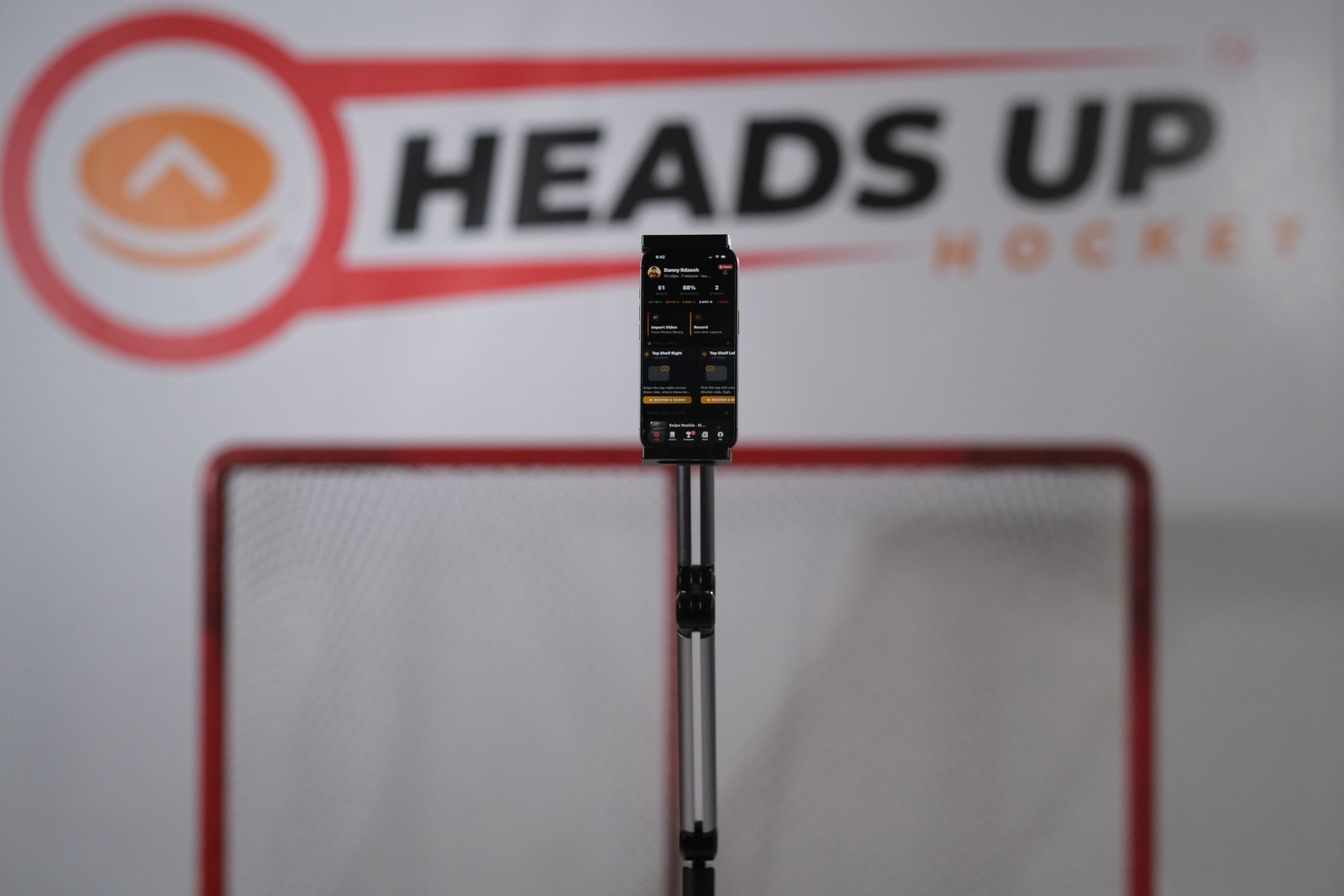
Heads Up Shooting uses your phone's camera to measure release time, shot speed, accuracy, and head-up rate — and shows you a placement map of exactly where every puck went. No radar gun, no sensors, nothing to mount or aim. You prop up your phone and shoot.
That last metric is the one nothing else on this list measures. Rhett Pitlick names it as the error he sees most: "they're shooting the puck with their head down, never looking up." A pad can't catch that. A radar gun can't catch that.
It's free to download, with lifetime access for $175 — one payment, no subscription.
What we'd actually buy
Starting out (about $120–$140): a shooting pad, a bucket of pucks, and the free app. Howies sells a pad-and-25-puck combo at $129.99, or a pad alone at $109.99 with a 10-pack of 6oz pucks at $20.50. That's a complete training setup, and you'll know within a month whether your kid reaches for it unprompted.
Serious about the off-season (about $500–$700): pad + tarp + passer + lifetime app access. Tarps run $220–$370 and passers $90–$160 — that's the bulk of the cost, and it buys you safety and game-realistic reps.
What we'd skip: a radar gun, unless shot speed specifically is what you're chasing. At $300–$400 plus a mount, it measures one of the four things that matter, and the model that logs readings to your phone is the $399.99 one.
⚠️ A real note on availability: as of 2026-09-25, HockeyShot's Roll-Up pad and Better Hockey's Extreme pad are still out of stock — unchanged since July. Sniper's Edge's pads are back in stock, now $79.97–$119.97 across sizes. Howies remains the reliable pick. Check stock before you plan around a specific product.
The part nobody tells you
The equipment isn't what makes players better. Volume and attention do. Every gear list on the internet is downstream of one boring fact:
"The hockey gods can't tell the difference between an on-ice or off-ice rep. It's just a rep."
— Coach Lance
And the reason to measure at all — the reason an app belongs in the setup next to the pad:
"You don't make any progress unless you track it."
— Coach Lance
Buy the pad. Get the reps. Track them so you know they're working.
Want to see whether the reps are paying off?
Download Heads Up Shooting free, or get lifetime access for $175.
Related reading: 7 Hockey Shooting Drills You Can Do at Home · How to Measure Your Hockey Shot Speed With Just Your Phone
Frequently asked questions
What is the best hockey shot trainer for a beginner?
A shooting pad and a bucket of pucks. Beginners need volume and a safe place to shoot, not measurement or game-speed reps. Add a tracking app once the basic mechanics are there.
Are hockey radar guns worth it?
They're accurate, but they measure only shot speed. Pocket Radar's models start at $299.99 and run to $399.99 for the one that connects to your phone, plus $25–$35 for a mount. They do work unattended in Constant-On mode, though battery life in that mode is about an hour. For a player training alone at home, a phone-based tracking app captures speed plus release time, accuracy, and placement for less.
How much should I spend on hockey training aids?
Start small. A pad and pucks plus a free app is a complete setup. Spend more only after your player has shown they'll train unprompted for a month.
Can an app really measure shot speed?
Yes. Heads Up Shooting uses your phone's camera to measure release time, shot speed, accuracy, and head-up rate, and maps where each puck landed — no extra hardware required.
What's the difference between Heads Up Shooting and Heads Up Crush?
Heads Up Shooting measures your shot. Heads Up Crush is the stickhandling trainer — a gamified daily 15-minute session. Different skills, different apps.


