

The best stickhandling drills build two things at once: soft, quick hands and the habit of keeping your eyes up. You can run all fifteen below in a garage or driveway with a ball and a flat surface. Ten to fifteen focused minutes a day will change your hands in a month — but only if you stop looking down, which is the part almost everyone gets wrong.
The rule that makes or breaks all of this
Stickhandling with your head down isn't practice. It's rehearsal for a bad habit.
If you spend a summer building lightning hands while staring at the ball, you've trained your hands to work only when your eyes are on the puck. In a game your eyes need to be everywhere else — reading the defender, finding the lane, seeing the goalie cheat. The moment you look up, the hands you built stop working.
Jovan Moore describes what it's supposed to feel like: "I was stickhandling, looking up, seeing different targets on the ice… eyes open at the same time."
Josie Hemp had to fix the opposite habit deliberately: "I've struggled with keeping my head down — stickhandling and shooting with my head down."
And it's the observation behind the whole company name:
"Even if the kid is 6, 7, 8, I tell the parents: look at your kid's eyes. Where are they?"
— Coach Lance
Practical rule: learn each drill with your eyes down until the pattern is there — usually a session or two — then never do it that way again. Put something at eye level to look at. If the drill falls apart when you look up, it isn't yours yet.
Setup
A ball (a smooth-surface stickhandling ball or a golf-ball-sized training ball), a flat surface, and a stick. A slide board or dryland tile helps but isn't required. That's it.
The 15 drills
Warm-up — building touch
- Wide dribbles. Big, slow side-to-side. Feel the ball on both sides of the blade. 60 seconds.
- Narrow dribbles. Tight and fast, ball barely moving. Speed comes from the wrists, not the arms. 60 seconds.
- Front-to-back. Push the ball forward and pull it back, blade cupping it each direction. 60 seconds.
Control — expanding your range
- Figure eights around the feet. The foundational hand-eye pattern. 90 seconds.
- Wide-to-narrow ladder. Start wide, tighten to narrow over 30 seconds, then widen again.
- One-handed top hand. Top hand only. Ugly and worth it — it's where real blade control comes from. 30 seconds each hand.
- Toe drags. Pull the ball toward you with the toe of the blade, reset, repeat.
- Around the body. Move the ball in a full circle around your feet, forehand to backhand.
Speed — quick touches
- Rapid-fire narrow. As fast as you can hold the pattern. Stop the moment it degrades.
- Two-touch tempo. Two quick touches, pause, two more. Trains rhythm changes, which is what actually beats a defender.
- Lateral shuffle handling. Move your feet side to side while handling. Hands and feet together.
Deception — hands that beat people
- Fake wide, go narrow. Sell the wide dribble, cut it short. Deception is a rhythm change, not a fancy move.
- Between-the-legs pulls. Slow first. This one takes weeks.
- Backhand toe drags. The side nobody trains, which is exactly why it works in a game.
Transfer — making it real
- Handle-to-shoot. Three touches, then shoot. Stickhandling in isolation is a party trick; stickhandling into a shot is a skill. This is the drill that connects this page to the rest of your training.
How to structure a session
Ten to fifteen minutes daily beats an hour on Sunday. Hands are a frequency skill — small, constant exposure.
A workable session: two warm-up drills, three control drills, two speed drills, one deception drill, and always finish with handle-to-shoot. Rotate which ones you pick so you're not just repeating your favorites.
Quality over speed, always. The moment the pattern breaks, slow down. Fast and sloppy trains fast and sloppy.
The measurement problem
Here's what makes stickhandling harder to improve than shooting: there's no obvious number.
With a shot you can measure speed, release time, and where the puck went. With hands, most players have no feedback at all beyond "that felt smoother." And the single most important variable — whether your eyes were actually up — is the one you're least able to judge, because checking requires looking.
Two things help.
Film a session. Thirty seconds of video tells you immediately how often your eyes drop. Most players are shocked. It's the stickhandling equivalent of Coach Lance's miss circle — you can't fix what you've never seen.
Use a drill that forces your eyes up. Have someone hold up fingers for you to call out, or put a target on the wall you have to track. If you can't report what you saw, your head wasn't up.
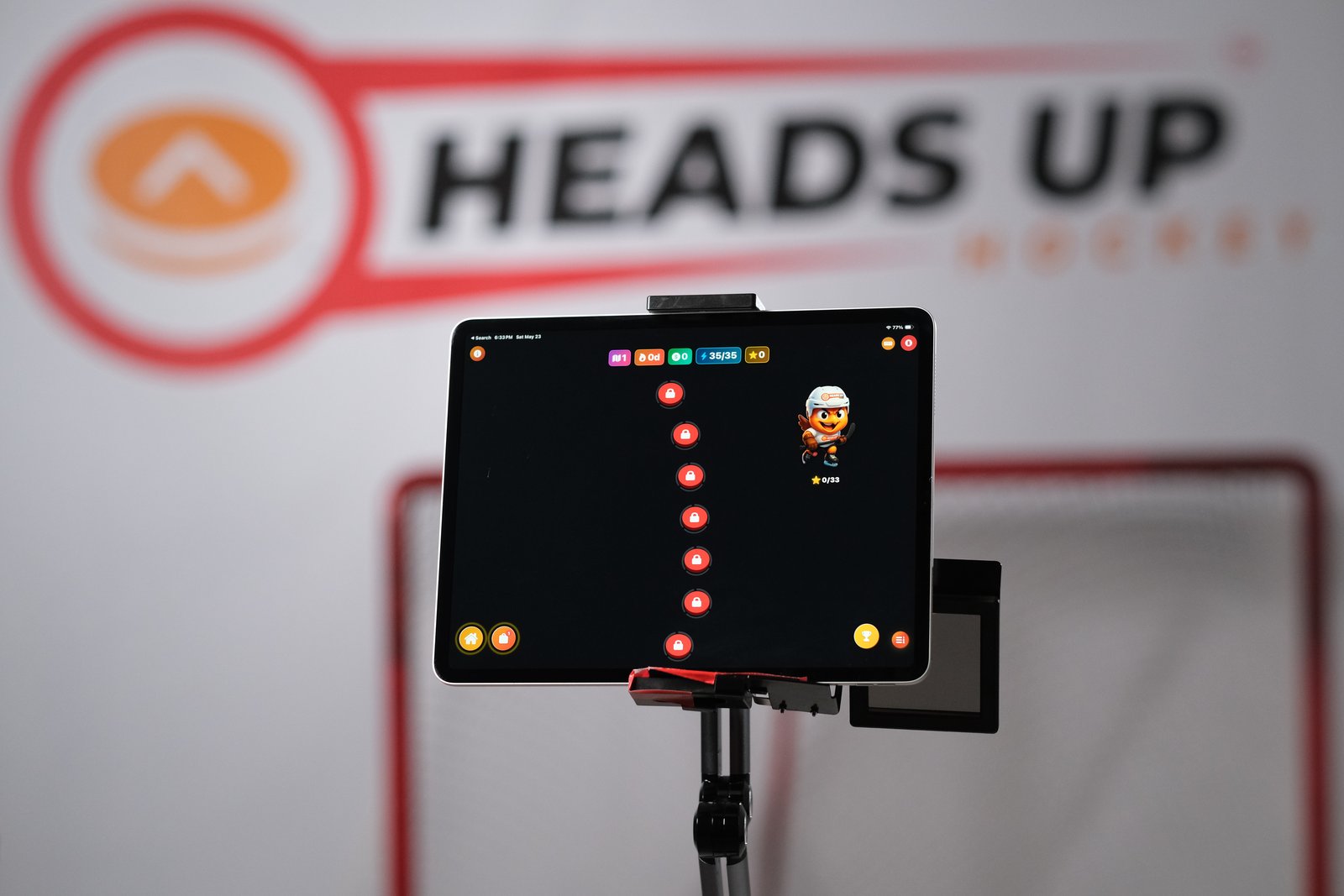
This is exactly the problem Heads Up Crush was built around. It uses your iPhone or iPad's rear camera, a stand, and a specialized mirror to track a puck or stickhandling ball on any surface in real time, then runs you through 200+ levels of guided drills across five foundational skills — with Coach Lance's voice in your ear the whole way, and a leaderboard to keep you honest. Its own in-app testing showed measurable hand-speed gains (up to +13.4% overall, split into vertical and horizontal components) from consistent sessions.
"You don't make any progress unless you track it."
— Coach Lance
Train on numbers, not vibes.
And when you're ready to shoot it
Hands get you into the scoring chance. The shot finishes it — and the same head-up principle applies there too.
Heads Up Shooting measures your release time, shot speed, accuracy, and head-up rate using just your phone. It's a separate app, built for the shot rather than the hands.
Try Heads Up Crush — hardware kit $59.99, with monthly ($14.99), annual ($12.99/mo), and lifetime ($350) access — or download Heads Up Shooting free on the App Store for the shot side, with lifetime access for $175.
Related reading: Off-Ice Hockey Training: The Complete Dryland Guide · 7 Hockey Shooting Drills You Can Do at Home
Frequently asked questions
How do you practice stickhandling at home?
A ball and a flat surface is the entire setup. Garage floors, driveways, and basements all work. Ten to fifteen focused minutes a day, working through wide dribbles, figure eights, toe drags, and quick-touch drills, is enough to change your hands in about a month.
How long should you practice stickhandling each day?
Ten to fifteen minutes daily beats one long weekly session. Hands are a frequency skill — short, consistent exposure builds them faster than occasional long blocks.
Should you look at the puck when stickhandling?
Only while first learning a pattern. After a session or two, do every drill with your head up. Stickhandling with your eyes down builds hands that stop working the moment you look up, which is precisely when you need them in a game.
What is the best stickhandling drill for beginners?
Figure eights around your feet. It builds the fundamental hand-eye pattern, works both forehand and backhand, and scales from very slow to game speed as you improve.
Do stickhandling balls work better than pucks off ice?
Yes, on most surfaces. A ball rolls smoothly on concrete or wood, where a puck catches and scrapes. Use a puck on a proper shooting pad or dryland tile, where it slides the way it does on ice.


